
GEO Agency Indonesia:
Understand how AI describes your brand
Epilog helps brands across Indonesia and Southeast Asia see how they show up in AI search answers, improve the sources those answers can draw on, and measure what actually changes.
Leading AI Engines
Logged AI visibility
across selected engines
Evidence-led priorities
reviewed by strategists
Clearer source material
with verifiable claims
Measured observations
without guaranteed outcomes
The discipline of being cited by AI.
- What is an AI GEO agency?
- An AI GEO agency improves a brand’s readiness for search and AI-assisted discovery through technical eligibility, clear and well-sourced content, consistent entity information, legitimate corroboration, and controlled measurement. Epilog Creative is an AI GEO agency based in Jakarta, Indonesia, serving brands across Indonesia and Southeast Asia.
- What is Generative Engine Optimization (GEO)?
- Generative Engine Optimization (GEO) is the practice of making your brand visible, citable, and recommended inside AI-generated answers from ChatGPT, Perplexity, Gemini, Claude, Google AI Overview, and Bing Copilot. Where SEO competes for clicks on a results page, GEO competes for inclusion inside the answer itself.
- What is AEO, and how does it relate to GEO?
- AEO (Answer Engine Optimization) focuses on making a page clear and useful for systems that present direct answers. In Epilog’s working model, GEO is the broader practice of improving how a brand and its sources can be found, represented, cited, or recommended across generative systems. The two overlap, so we treat them as one connected discipline.
- Mentioned.
- Cited.
- Recommended.
| Dimension | SEO | AEO | GEO |
|---|---|---|---|
| Primary goal | Organic discoverability and ranking | Direct-answer eligibility and extractability | Brand and source visibility in generative answers |
| Typical surfaces | Search results, snippets, maps | Featured snippets, voice answers, AI summaries | ChatGPT, Gemini, Perplexity, AI Overviews, Copilot |
| Typical signals | Relevance, technical health, authority, links | Clear answers, semantic coverage, evidence, structure | Search eligibility, entity clarity, evidence, mentions, corroboration |
| Measurement | Rankings, impressions, clicks | Answer inclusion and attribution | Mention, citation and recommendation frequency; share among named brands |
The three overlap and stack rather than compete. The columns show emphasis, not hard boundaries: Google AI Overviews in particular sit across AEO and GEO, and no single signal wins an answer on its own.
The shift is already happening.
These figures describe different studies and populations. They are context for measurement, not a forecast for any individual brand.
From ranked results to synthesized answers.
Search results and AI-generated answers are different surfaces, and both can show multiple sources. They need separate definitions, evidence, and measurement.

Established Search
Traditional SEO
Search visibility is observed through established crawl, index, ranking, impression, click, and conversion data.
- Ranked links, snippets, maps, and other search features
- Visibility measured through impressions, clicks, and rankings
- A click usually moves the user to a source page
- Crawlability and indexation remain foundational

Additional Layer
AI Search (GEO)
AI products may synthesize an answer, display links, or cite several sources. The format and sources can change between products and runs.
- A synthesized answer may draw on and cite several sources
- Brand mentions and links to owned pages are separate outcomes
- Answers can vary by product, query, language, location, and run
- Repeated, logged observations are needed to describe visibility
Search performance and AI-answer visibility should be measured separately, then read together.
A clearer way to inspect AI search.
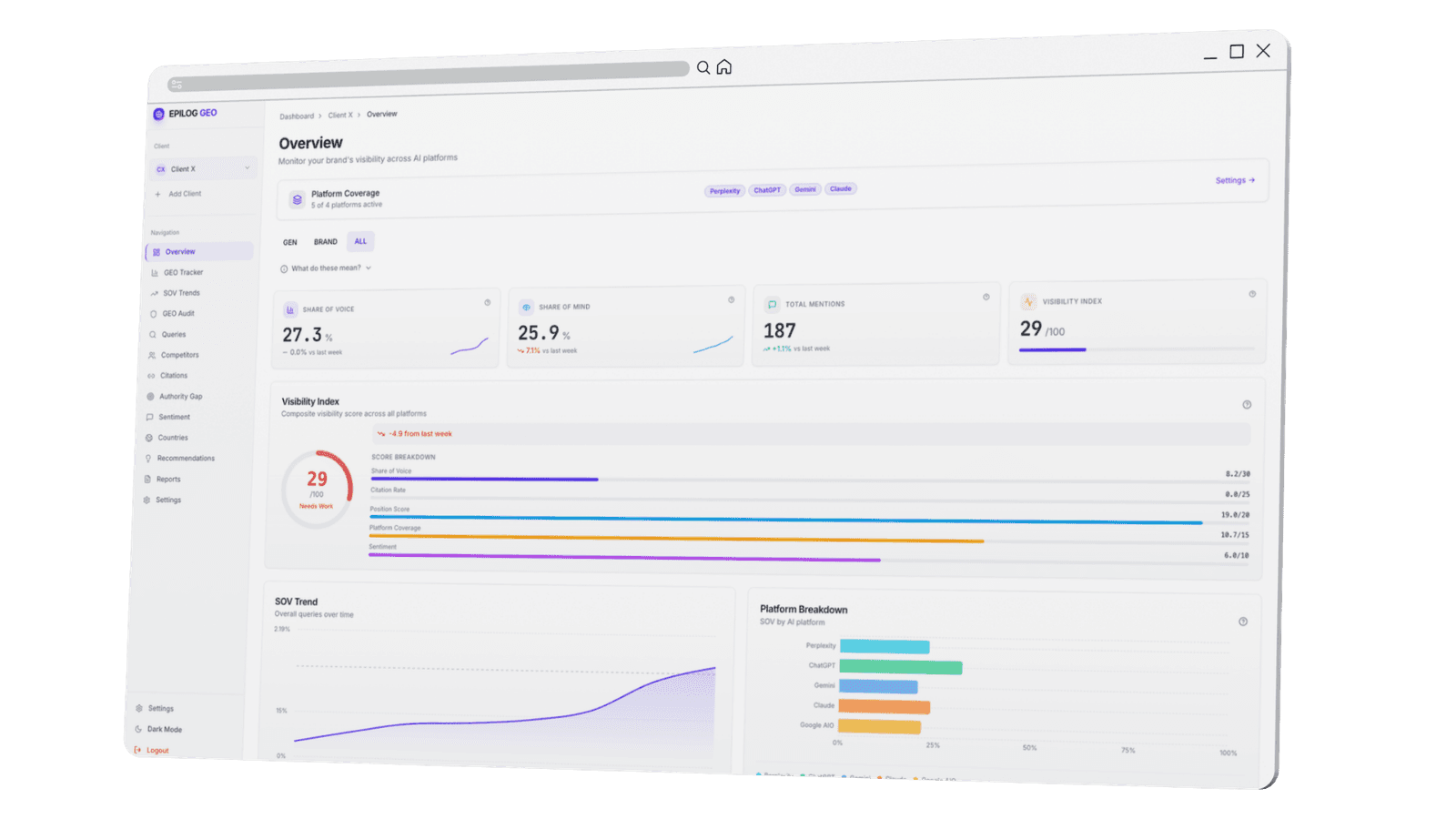
The interface below is an illustrative concept with sample data. Client reporting is produced only after an agreed panel has been run and logged.
Multi-Engine Measurement
Compare logged answers across the AI products that are relevant to your buyers.
Sample Visibility Over Time
SOV Reports
A sample Share of Voice view. The final metric and cadence are defined in the measurement plan.
Keyword Tracking
Compare a fixed set of buyer questions across retained panel runs.
Competitive Intelligence
Inspect which brands and sources appeared, then investigate possible explanations.
Illustrative competitor movement
Sample competitor gained +14% sample visibility in this illustrative view.
Content Optimization
Prioritized content recommendations tied to observed source and evidence gaps.
Sample recommendation
Create a comparisons guide for "Brand vs Competitor"
Strategic Consulting
Review sessions turn logged observations into a practical roadmap.
Continuous Tracking
Rerun the agreed panel and compare the retained answers over time.
Sample mentions
A systematic approach to understanding AI answers.
Four steps that turn uncertain AI outputs into a documented baseline, a focused work plan, and a comparable rerun.
Discover
Where do you appear, and where don't you?
We agree the products, languages, locations, and buyer questions to test, then retain the first logged baseline.
- Prompt set design
- Audience query mining
- Brand baseline scan
Analyze
What makes competitors get cited?
We separate mentions, owned citations, third-party sources, and answer accuracy, then identify evidence gaps worth investigating.
- Competitor benchmark
- Citation source audit
- Sentiment & entity gap
Optimize
Content that AI wants to cite.
We improve crawlability, structured data, factual consistency, and source-backed content without promising a citation.
- Answer-ready pages
- Structured data & schema
- Internal linking & source strategy
Track
Repeat the same panel and compare.
We rerun the agreed panel at the project cadence and report observed changes alongside unchanged and negative results.
- Scheduled panel reruns
- Logged answer comparison
- Evidence-led trend review
Six layers of authority infrastructure.
GEO isn't one tactic. We work across the technical, editorial, and reputational signals that decide whether AI engines cite you, or someone else.
Website & Technical SEO
Crawlability, structured data, schema markup, internal linking, and Core Web Vitals: the technical foundation AI engines actually parse.
AI-Readable Content
Answer-first writing, clear headings, definition blocks, and citation-worthy formatting that LLMs can lift verbatim.
Entity & Brand Authority
Knowledge graph alignment, consistent brand entity signals, and authoritative profiles so AI knows exactly who you are.
Citation & Source Strategy
Earning placements on the third-party sources AI engines trust most when answering category questions.
Competitor Gap Closing
Reverse-engineering why AI cites your competitors today, then closing the content, entity, and authority gaps.
Local Indonesia / SEA Relevance
Localized prompts, Bahasa Indonesia coverage, and regional source strategy for Jakarta, Surabaya, KL, Singapore, and beyond.
Measurement and strategy that work together.
You get a documented measurement process plus strategic guidance. The goal is a decision-ready view of your brand, not a score that hides how it was produced.
Indonesia & SEA Context
- Bahasa Indonesia and English prompt design
- Regional sources reviewed in context
- Market assumptions stated before testing
Process + Human Review
- Logged prompts, answers, citations, and screenshots
- Strategist review of ambiguous outputs
- Priorities tied back to retained evidence
Integrated Agency Context
- SEO, content, strategy, and technical work connected
- Ordinary search foundations checked first
- GEO outcomes kept separate from campaign results
Outcome Focused Partnership
- Scope based on relevant buyer questions
- No guaranteed citation or recommendation
- Unchanged and negative results stay in the report
We are applying the same evidence standard to ourselves.
GEO started as an internal measurement question: what do AI search products actually say about Epilog, and can we reproduce the observation?
We are building a logged panel and reporting framework around that question. Until a baseline has been run and retained, interface examples on this page remain illustrative rather than evidence of measured performance. The method is simple: document first, then improve, rerun, and report only what was observed.
We document whether selected AI products mention or cite you.
No citation is guaranteed.
We ran the program on a site we operate.
One quarter of first-party Search Console data from a B2B professional services website we run ourselves. Comparing the first 30 days of the window with the last 30:
- Clicks
- +144%
- Impressions
- +105%
- Click-through rate
- +0.29pp
- Pages in AI features
- +11%
The other half matters just as much. Most of that growth is branded demand. Non-brand commercial queries produced almost no clicks, average position got worse as the site surfaced for more terms, and a snippet rewrite on the biggest commercial page changed nothing measurable. No AI citation rate is claimed anywhere, because no controlled panel has been run.
Read the full record: method, measurement, and what did not workIs GEO right for you?
GEO works best for brands willing to build authority over time, not for those chasing quick hacks.
Good Fit
- Brands already investing in content marketing
- Companies in competitive, information-rich industries
- Leadership that thinks in 12-24 month horizons
- Teams ready to iterate on content strategy
Best results when authority-building is already part of your growth strategy.
Not a Fit
- Looking for overnight results
- No existing content or digital presence
- Purely transactional, low-consideration products
If you need instant wins, GEO is probably not the first lever to pull.
Think of GEO as authority infrastructure, not a quick campaign.
Not sure where you fit?
Let's assess your brand's readiness together.
Start with what we can verify.
Run a technical readiness snapshot of one homepage. It checks retrieval, crawler controls, structured data, and content structure. A separate single-model sample is experimental and is not a cross-engine visibility score.
- Homepage retrieval check
- Crawler-control review
- Structured-data inspection
- Content-structure checks
- Clearly labelled single-model sample
- Findings tied to the submitted site
- Prioritized technical recommendations